

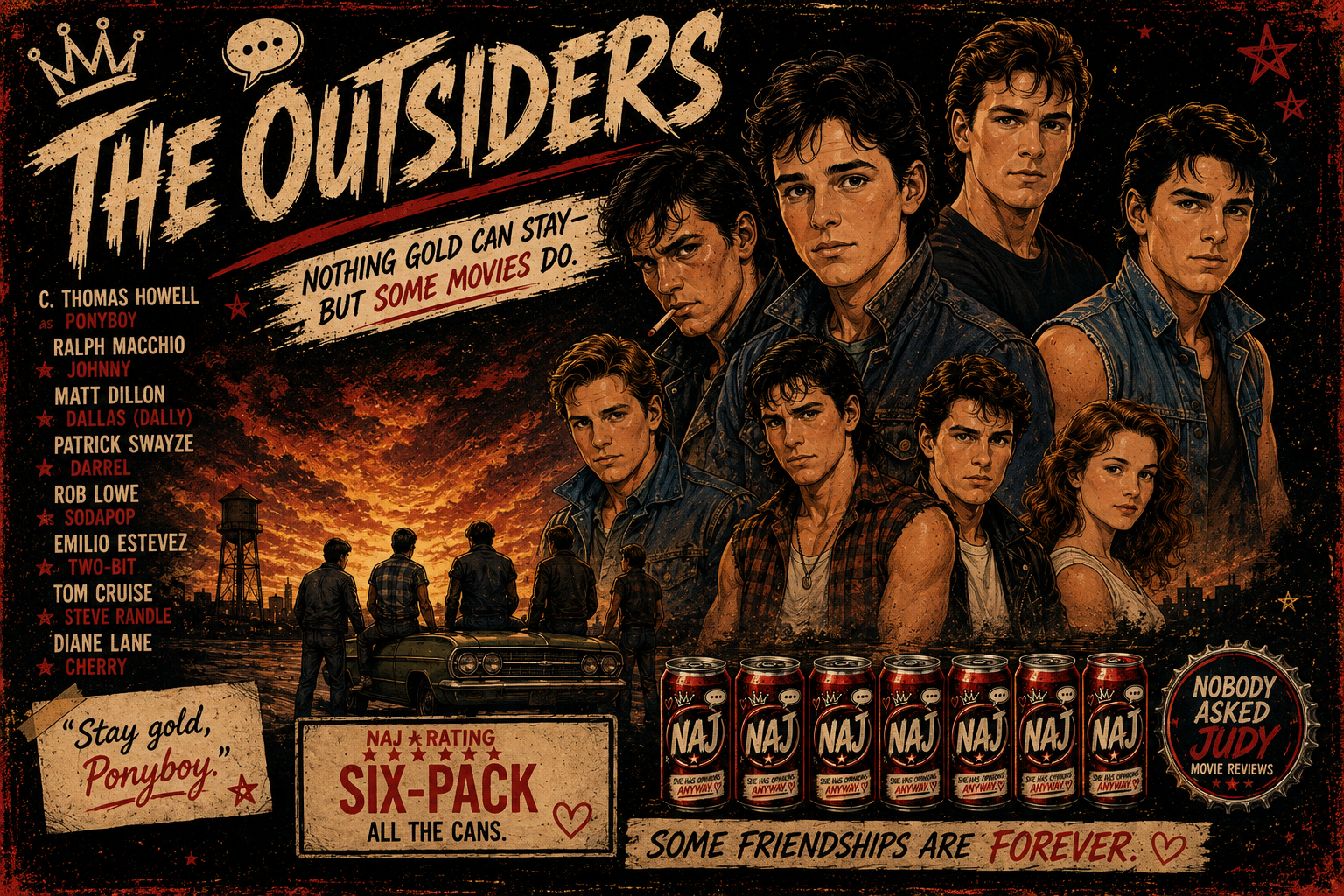
There are movies you remember because they were good.
There are movies you remember because you saw them at exactly the right age.
And then there are movies that quietly become part of the scaffolding of who you are.
The Outsiders is one of those movies for me.
I first saw it in the summer of 1984. My great-uncle used to tape movies off HBO onto VHS and give them to my dad, which meant we had what felt like an endless supply of movies to watch. Movies were my summers. At least one a day, sometimes more.
And somewhere in all of those VHS tapes was The Outsiders.
I was about ten years old.
I had no idea at the time how much that movie—and later, the book—would stay with me.
A Story Written by a Girl
I didn’t read S. E. Hinton’s book until later, and I will say this right now: books are always better than movies.
Always.
That is my personal law, and I will not be taking questions.
But The Outsiders was different because learning about the person who wrote it mattered almost as much to me as the story itself.
Hinton began writing the book as a teenager and finished it while she was still incredibly young. That stayed with me.
A girl had written this.
A young girl.
She had created characters people cared about. She had written something that mattered enough to become a book, then a movie, then something generations of people would carry around with them.
That made writing feel possible.
I don’t know if ten-year-old me consciously sat there thinking, “I am going to be a writer now.”
Probably not.
But something clicked.
Someone young could create something that lasted.
Someone like me could write something that mattered.
That mattered.
Johnny
My favorite character was Johnny.
He still is, really.
I don’t think I understand Johnny differently now than I did when I was ten. I understood him then.
I understood why he did what he did.
I understood the fear behind it. I understood why someone pushed far enough could react the way he did. I understood the kind of self-hatred that would follow afterward.
The thing adulthood changed wasn’t my understanding of Johnny.
It was the amount of pity I feel for him.
As a kid, I identified with him.
As an adult, I look at him and think about how little chance he ever had.
Johnny spends so much of the story afraid. Afraid at home. Afraid of the Socs. Afraid of what he has done. Afraid of what comes next.
And then, for this tiny window of time, something changes.
He discovers courage.
He saves children.
He realizes his life has value.
He gets a glimpse of something better.
And then he dies.
Johnny didn’t get the chance to bloom when the light finally reached him.
That is what destroys me about him.
Nothing Gold Can Stay
Robert Frost’s “Nothing Gold Can Stay” became my favorite poem because of The Outsiders.
The book and movie gave the poem meaning for me before I ever cared about academically dissecting poetry.
Things are beautiful partly because they cannot last.
Childhood doesn’t stay.
Innocence doesn’t stay.
People don’t stay.
Moments don’t stay.
Johnny doesn’t stay.
And somehow that makes “Stay gold, Ponyboy” one of those lines that follows you through life.
It isn’t just telling Ponyboy to stay innocent.
It is asking him to hold onto the part of himself that can still see beauty even after seeing terrible things.
That is a much harder thing to do.
Dally
And then there is Dally.
Dally’s death still wrenches my gut.
To this day.
Johnny was one of the few things Dally genuinely cared about, and when Johnny died, whatever thin thread was keeping Dally attached to the world snapped.
By the time he confronts the police, he isn’t trying to get away.
He is making a decision.
And watching that happen still hurts.
There is something devastating about realizing that Johnny was, in his own way, Dally’s gold.
And he couldn’t stay.
Patrick Swayze Had the Harder Job
For me, the best performance in the movie belongs to Patrick Swayze as Darrel.
Darry could have been a very easy character to get wrong.
He is strict.
He is angry.
He puts enormous pressure on Ponyboy.
For part of the movie, especially if you are young, he can almost feel like an antagonist.
But Darry isn’t simply the mean older brother.
He is a young man who suddenly has to become a parent.
He has lost his own parents. He has given up pieces of his own future. He is trying to hold his family together while having absolutely no idea how to do it.
Swayze had to make all of those things exist at the same time.
And he did.
The love is buried underneath the frustration, exhaustion and fear, but it is there.
That is a harder character to portray than somebody who mostly stands around looking intense.
Which brings us to—
Tom Cruise
Worst performance?
Tom Cruise.
Yes, I said it.
Come down off Oprah’s damn couch.
Compared with some of the performances around him, he just does not leave much of an impression on me in this movie.
And before anyone gets upset, please remember the name of this website.
Nobody asked me.
Good Lord, Everybody Is in This Movie
Looking at the cast now is almost comical.
C. Thomas Howell.
Ralph Macchio.
Matt Dillon.
Patrick Swayze.
Rob Lowe.
Emilio Estevez.
Tom Cruise.
Diane Lane.
It feels like someone accidentally gathered half of the next decade of Hollywood and shoved them into one film.
Some of them were still becoming who we now know them as.
That makes revisiting the movie even more interesting.
You aren’t just watching The Outsiders anymore.
You are watching a strange little time capsule full of people who were about to become enormously famous.
Ralph Macchio and the Crime of 1987
Now we need to discuss something extremely serious.
Ralph Macchio was my one true teenage love.
I liked Ralph Macchio enough that I created my own Ralph Macchio magazine.
Not bought.
Made.
I went through teen magazines, took the best photos of him, and assembled them into one glorious Ralph Macchio super-publication.
This was art.
This was journalism.
This was devotion.
And then somebody stole it out of my locker.
The scene of the crime:
Central Dallas K–12.
Minburn, Iowa.
Junior high lockers.
Suspects:
The Ward Twins + Theresa.
I have not forgotten.
I will not forget.
Nobody Asked Judy considers this an open investigation.
C. Thomas Howell Still Makes Me Smile
C. Thomas Howell has always made me smile.
There is just something about him.
And apparently that has not worn off with age, because decades later I still enjoy seeing him pop up in things.
Especially Obliterated.
There are actors you associate with one role forever, and then there are actors who feel a little like unexpectedly seeing somebody you used to know.
Howell is one of those for me.
Ponyboy stayed somewhere in the back of my brain, and every time Howell appears on screen, part of me seems to recognize him before the rest of me does.
Has It Aged Badly?
People love asking whether old movies have “aged well.”
I don’t really know how much that applies here.
The Outsiders is already depicting another time.
It is a story rooted in the late 1950s and early 1960s, filmed in the early 1980s.
There are no giant digital effects to laugh at.
There is no futuristic technology that accidentally looks ridiculous forty years later.
It is people.
Cars.
Clothes.
Violence.
Friendship.
Family.
Class.
Grief.
Those things don’t become obsolete.
You can certainly look at the filmmaking through a modern lens, but emotionally, the story still works because the things these kids are dealing with still exist.
Kids still feel trapped.
Kids still divide themselves into groups.
Kids still get hurt by adults who are supposed to protect them.
Kids still desperately want somewhere to belong.
That hasn’t aged out.
And Then Ponyboy Starts Writing
The ending may be the part that means even more to me now.
Ponyboy sits down to write.
And he begins:
“When I stepped out into the bright sunlight…”
And suddenly we understand.
The story we have just watched becomes the story he writes.
It circles back to the beginning.
I love that.
I have always loved stories that come full circle, and it is something I strive to do in my own writing.
There is something deeply satisfying about reaching the end of a story and realizing the ending was waiting inside the beginning the entire time.
Ponyboy takes everything that happened—the fear, Johnny, Dally, his brothers, the violence, the grief—and turns it into something.
He writes it down.
He makes something out of it.
Maybe that is part of why this story stayed with me.
The NAJ Rating
Six-Pack. All the cans.
There was never really another possibility.
The Outsiders is not a perfect movie.
I still think the book is better.
Tom Cruise is still in it.
But none of that matters enough to take away a can.
Some movies entertain you.
Some movies impress you.
Some movies become part of your history.
This one became part of mine.
In the summer of 1984, I was a ten-year-old girl watching an HBO recording on VHS because movies were what I did during the summer.
Somewhere inside that movie was another young girl who had written a story people cared about.
Somewhere inside that story was Johnny, who I understood.
Somewhere inside it was a poem that would become my favorite.
And at the end was Ponyboy, sitting down and turning everything that had happened to him into words.
I didn’t know then how much that would matter to me.
I do now.
Nothing gold can stay.
But some stories do.